#IBDepictingArt

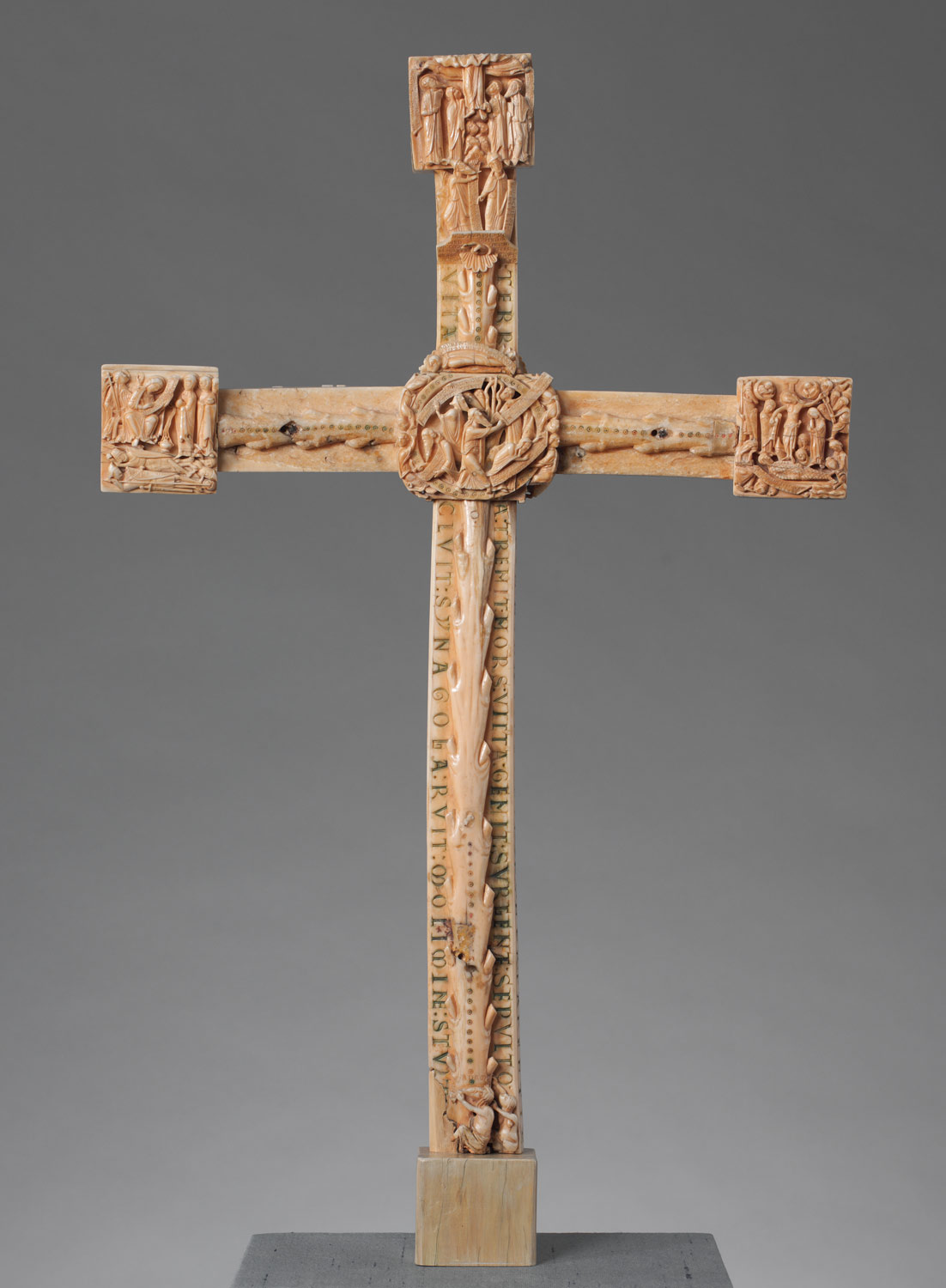
Artist: N/A (from Britain)
Title: The Cloisters Cross
Date: ca. 1150–60
Medium: Walrus ivory
Size: Overall: 22 5/8 x 14 1/4in. (57.5 x 36.2cm)
shaft: 12 3/8 x 1 11/16in. (31.4 x 4.3cm)
shaft-thickness: 1 1/4in. (3.2cm)
top piece: 8 1/8in. (20.6cm)
Cross piece: 9 3/4in. (24.8cm)
Central medallion: 2 5/8in. (6.7cm)
Terminal plaque: Mark: 2 1/4 x 2 5/16in. (5.7 x 5.9cm)
Terminal plaque: Luke: 2 5/16 x 2 1/8in. (5.9 x 5.4cm)
Terminal plaque: John: 2 5/16 x 2 1/4in. (5.9 x 5.7cm)
Thickness, each: 1 1/2in. (3.8cm)
to: 1 5/8in. (4.1cm)
2. The cross was constructed in between ca. 1150 - 1160 somewhere in Great Britain.
3. This is a carving of a cross with details engraved on it made out of walrus ivory. The little engravings on the cross are the true meaning of what its message is. On the left of the cross shows scenes from Jesus' resurrection and on the right there's images of Hebrew profits holding a scroll of his own words. Along with images of the lion of Mark on the left, the ox of Luke on the right, and the eagle of John on the top; the angel of Matthew once on the bottom is lost.
4. There is no color in the carving of the cross but there is a lot of detail put into it. All of the detail shown on the cross can show that the creator put a lot of time and effort into making it and it meant a lot to him/her. With all of the references to people/events in the bible, it can be more meaningful to its audience, which is probably Christians.
5. This cross, obviously, has a religious context. The cross is a symbol of atonement and reminds Christians of God's love to them. This piece was created in 1150 - 1160, which was within a hundred years of the revival of Christianity (http://www.localhistories.org/christiantime.html). I believe that this cross was created in order to show all others many examples of important events and people of the Bible through a sculpture of a cross, which resembles God's love. This piece of artwork has survived hundreds of years which shows its significance to history and it has significance to the Christian people because it is a cross. I believe that the meaning of the cross has the same meaning as it does then compared to when it does now. The only difference is the context of the time because back then there was a revival of Christianity in Great Britain but now Christianity has always been around. This piece of work has a lot of value in today's society. It shows how Christianity thrived in Great Britain as well as how the artist wanted to provide important pieces of the Bible into his/her carvings.

I loved how you analysed the photograph! At first glance, I though it was just the normal Christian cross; however, you made it clear that the little engravings on the cross tell a deeper meaning. Additionally, I agree that this conveys a religious context because the cross is a symbol used in Christianity. Personally, I think that this image also conveys a social context. This is because it shows how religion was very important to society when making decisions and it shows what they value. Moreover, I liked how you compared the cross in the 1150-1160 to how Christians interpret the cross today.
ReplyDeleteI think you did a really good I explaining how the religious context of this work of art has changed over time, as well as what was detailedly pictured in each of the ends of the cross. I didn't truly appreciate this work of art until you talked about its detail, which made me zoom in on the artwork, and just wow. That detail is remarkable. Finally, I thought your drawing was exquisite.
ReplyDeleteSome good thoughts here- I think the step-by-step organization served you well. I caution you in your final section- there are some generalizations/assumptions in your interpretation. Be careful thinking too much in terms of symbolism..that's where we often move away from good critical analysis.
ReplyDeleteI think you did a good job recreating this art piece and you analyzed it really well. I think the religious context of it is super interesting and gives it a lot of meaning!!
ReplyDelete